The Growing Importance of Estate Planning for Financial Advisors
1️⃣ Estate Planning Starts with Wealth Planning, Not with Legal Instruments
Estate planning can frequently begin with by a simple question “Do you have a Will?”.
How do we progress from talking the elements of a legal instrument to financial planning? For many advisors who are not aware or trained in estate planning, they do not understand that how the assets are distributed requires more planning than just slotting in beneficiaries’ names and identification numbers.
Financial advisors will have to build on that beginning question to progress to a clarity of values, intentions, and long-term objectives.
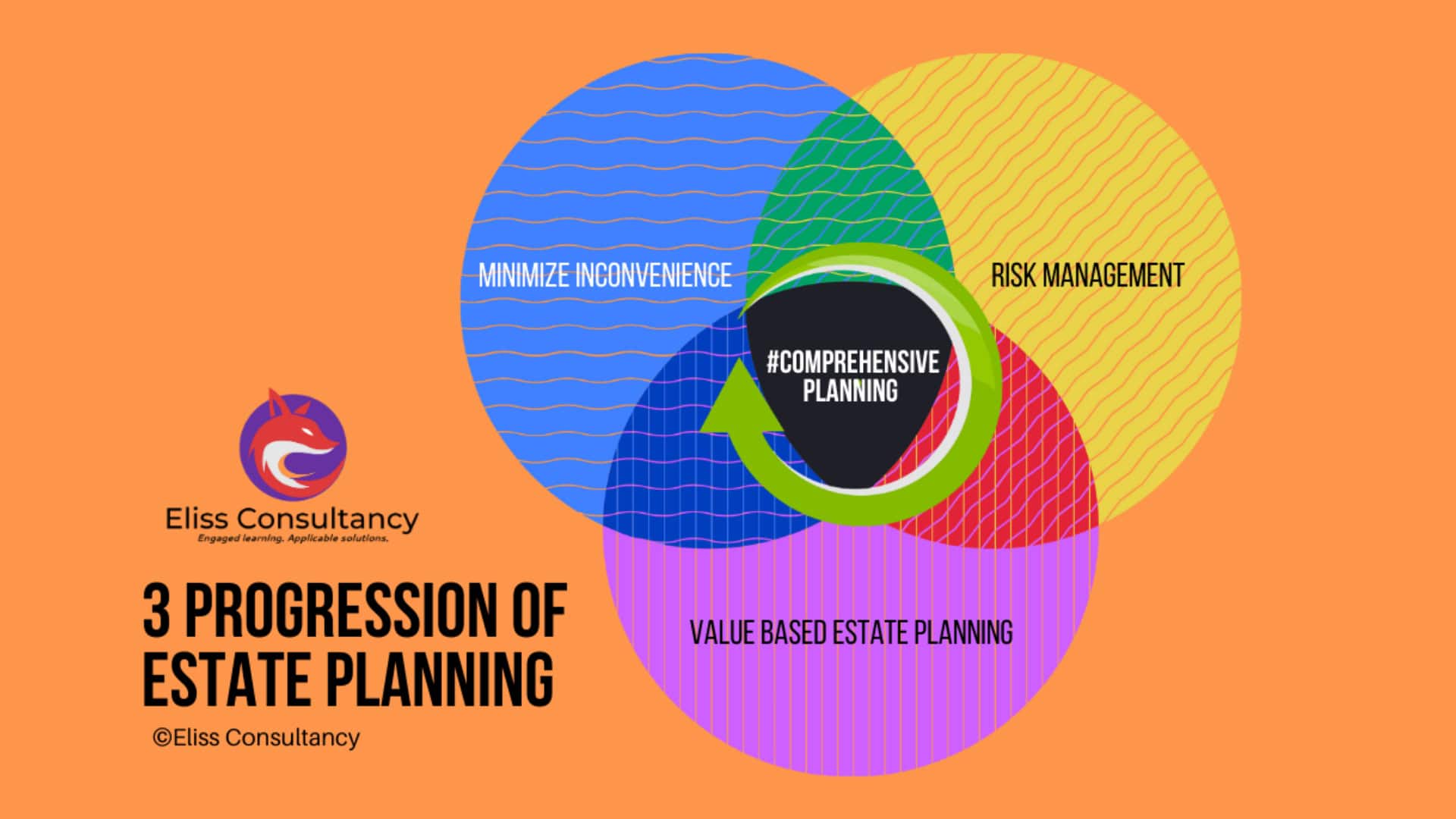
Below are the common 3 progression of Estate Plans (can be simultaneously overlapping):
- The Minimization of Inconvenience
- Primarily Risk Management
- Value Based Estate Planning
For holistic estate planning, the starting point includes:
- What does the client wish for their wealth to achieve after their lifetime?
- What values or principles do they want their family to continue to possess?
- How should wealth be used? Is it to educate or to enable independence? Can harmony be preserved or even enhanced during the wealth distribution phase?
Legal tools such as Wills, Trusts, CPF nominations, and insurance solutions are simply instruments to implement those values. Estate planning is thus a continuation of wealth planning, not a separate or purely legal process.
2️⃣ Why Financial Advisors Are Key to Estate Planning
Financial advisors already possess unique strengths that position them to lead in this space:
- Trained in wealth preservation and protection, the foundation of estate planning.
- Hold a holistic, bird’s-eye view of their clients’ financial lives.
- Maintaining long-term relationships, sometimes spanning more than 1 generations.
- Build family-based portfolios, naturally becoming the bridge between generations.
Moreover, advisors can hand over their own practice to successors, ensuring continuity of service to their clients’ families.
This continuity gives them an advantage over purely transactional service providers like the banks.
3️⃣ Where Are Financial Advisors Now?
Despite this potential advantage, many advisors remain geared toward traditional insurance and retirement planning, instead of developing estate planning expertise.
Common patterns include:
- Heavy focus on protection and retirement, with limited or no estate planning engagement.
- Belief that “estate planning = Will writing.”
- Lack of clear financial reward models for estate planning.
- Minimal awareness of how insurance and nominations link into broader estate strategies.
| Current Advisor Focus | Missing Link | Estate Planning Connection | ||
|---|---|---|---|---|
|
Insurance protection |
Inter-generational wealth understanding |
How insurance proceeds can be used as
wealth transfer across generations
|
||
|
Retirement planning |
Legacy considerations |
Continuity of income for dependents after death e.g. spouse |
||
|
Asset accumulation |
Distribution awareness |
Structuring ownership and trusts for fairness & tax efficiency |
||
4️⃣ What Financial Advisors Can Do
Practical steps for been ready to provide estate-planning services for their clients:
- Learn the basics — Understand Wills, Trusts, CPF nominations, joint ownership rules, and insurance nominations
- Engage clients in conversation — Discuss values and legacy before legal instruments
- Collaborate with experts — Work with legal professionals, Will-writing and trust companies to offer integrated solutions
- Create awareness — Conduct public or client talks on estate planning; education builds trust
Advisors who do this early will evolve from product specialists to family wealth advisors — a far more enduring and respected role.

5️⃣ What Estate Planning Is Not About
Estate planning is not about:
- Generating leads just to draft simple Wills
- Merely warning clients that “dying intestate is inconvenient”
- Treating estate planning as a referral pipeline for lawyers
It is about continuity, structure, and meaning — aligning financial resources with life goals and family values beyond their lifetime.
6️⃣ The Shortfall in Skills and Knowledge
To integrate estate planning into financial practice, advisors need both technical skills and emotional intelligence.
Key gaps include:
- Understanding estate planning basics
- Overcoming the taboo of discussing death and legacy
- Moving beyond nominations and intestacy
- Seeing how assets can sustain families beyond one generation
- Recognising how quickly wealth can be lost without structure
- Presenting estate planning as empowerment, not fear
- Been able to handle from a single client’s needs to complex family relationship dynamics
When advisors gain these skills, they evolve from insurance policies marketers to trusted generational wealth partners.
7️⃣ A Call to Action — Elevate Your Practice
As Singapore transitions into a mature wealth society, financial advisors stand at the crossroads of opportunity and relevance. Estate planning will increasingly become an expected part of holistic financial advice — not a niche service.
That’s why Eliss Consultancy created the Estate Planning Series and Enhanced Skills Advisory Training (e-SAT) Programme — for advisors who want to:
- Understand real-world estate planning and distribution scenarios in Singapore
- Build advisory confidence across generations
- Create meaningful, values-based relationships with clients
Final Thoughts
Estate planning is no longer a back-end legal afterthought — it is becoming the frontline of financial advisory service.
In a Singapore where asset growth is slowing and family structures are evolving, advisors who integrate Will Writing Singapore, estate structuring, and multi-generational planning into their practice will become the advisors whom families trust most.
It is Eliss’ prediction that the next wave of successful financial advisors will not only protect and grow wealth — they will help preserve and purpose the wealth created for future generations.